
November 2026 marks exactly 25 years since the death of Malawi’s reggae king, Evison Matafale, who died on 27 November 2001 at Kamuzu Central Hospital in Lilongwe while in police custody.
In the aftermath of his passing, two parallel inquiries were instituted to investigate the circumstances surrounding his death. Unprecedentedly, and rather surprisingly, both inquiries were state-sponsored and funded.
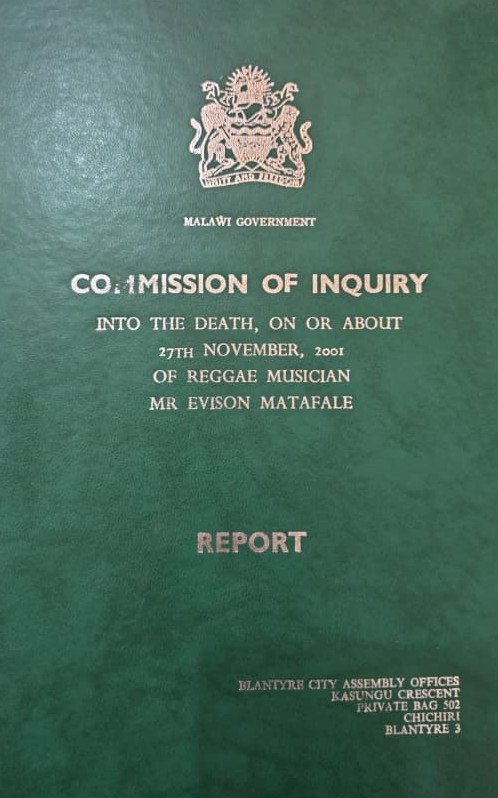
One inquiry was established by the President of the Republic of Malawi, Dr Bakili Muluzi, on Tuesday, 4 December 2001. The Malawi Human Rights Commission (MHRC) also set up its own Human Rights Committee of Inquiry, comprising officials drawn from the Malawi Human Rights Commission, the Office of the Ombudsman and the Malawi Prisons Inspectorate.
Both inquiries were, however, surrounded by controversy. Questions were raised about the manner in which the inquiries were constituted, the composition of the investigative teams, and ultimately, their findings and determinations. Even after the reports were completed and submitted to the Head of State, questions about truth, accountability and justice for Evison Matafale have persisted among sections of the public to this day.
More concerning is that the two reports gradually disappeared from the public domain. For years, they became virtually inaccessible, with neither online searches nor public library collections readily yielding copies of these important historical documents.
As part of commemorating the 25th anniversary of Evison Matafale’s passing, researchers at the Lost History Foundation (LHF) have retrieved hard copies of both reports. LHF has since digitised the reports to make them accessible to the public and is undertaking a critical analysis of their findings, conclusions and determinations.
Through a special series commemorating Evison Matafale this month, LHF will share insights from its critical examination of the two inquiry reports. The series seeks not only to recover important historical records but also to reopen scholarly and public conversations about the circumstances surrounding Evison Matafale’s death, the search for truth, institutional accountability and the pursuit of justice.
Stay tuned!