
By Ali Gunde
For decades, the armed uprising led by Malawi’s former Minister of Home Affairs, Yatuta Chisiza, in October 1967 has largely been remembered as a small internal rebellion confined to Malawi’s south-western district of Mwanza. However, a newly released book argues that the event was far bigger than a domestic confrontation — it was a chapter in the wider history of the Cold War and the liberation struggles that shaped Southern Africa.
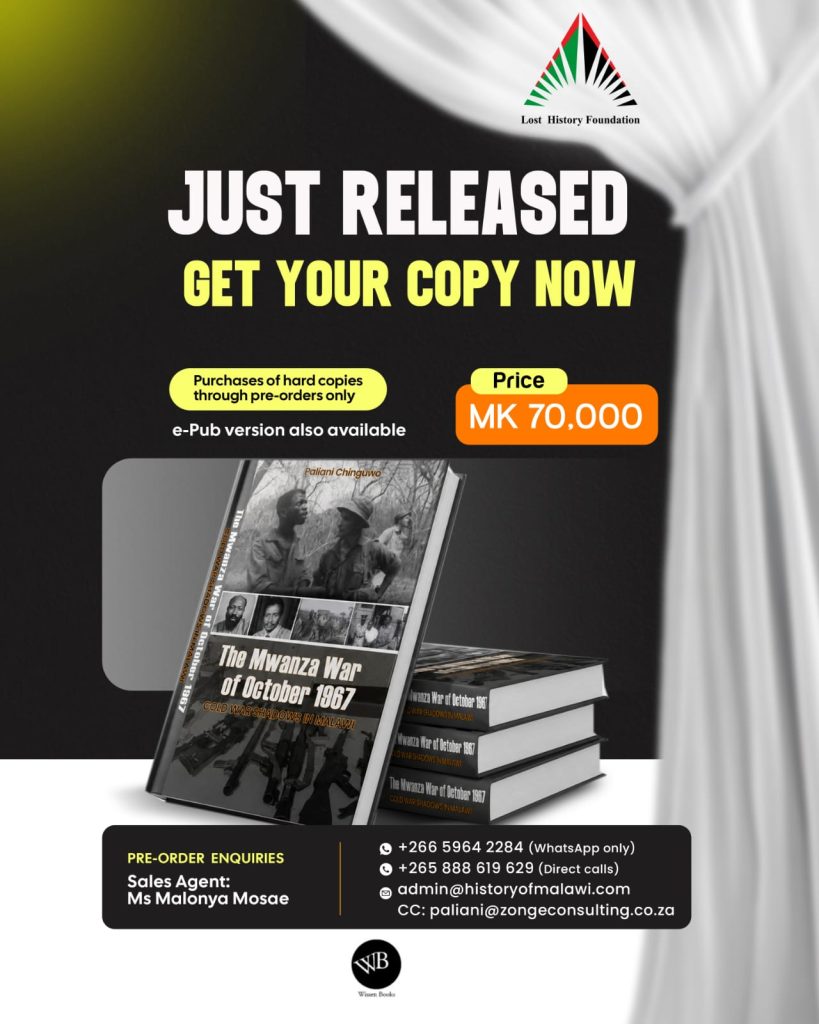
The Lost History Foundation (LHF), in collaboration with Wissen Books, has released *The Mwanza War of October 1967: Cold War Shadows in Malawi*, written by Paliani Chinguwo (PhD). The book re-examines the events surrounding the 17 armed fighters led by Yatuta Chisiza and places the Mwanza “War” within the broader regional and global political struggles of the 1960s.
The book challenges the tendency to view the Mwanza “War” only through the lens of Malawi’s internal politics. Instead, it presents the event as a meeting point between Malawi’s political history, the global ideological battle of the Cold War, and the armed liberation movements fighting against colonial and minority rule in Southern Africa.
According to the book, Yatuta Chisiza and his fighters did not operate in isolation. Their mission was linked to a wider network of political and military movements across Africa and beyond. The fighters received various forms of military, financial and logistical support from countries including Tanzania, China, Algeria, Cuba and USSR, among others.
They also benefited from assistance from liberation movements such as the African National Congress (ANC) of South Africa and the Zimbabwe African People’s Union (ZAPU), reflecting the interconnected nature of resistance politics in Southern Africa during that period.
The journey of the 17 fighters itself reveals a regional liberation network. Before entering Malawi, they had converged in Tanzania, where they lived together as displaced people from Malawi (on political grounds since Malawi’s cabinet crisis of 1964) at the United Nations (UN) Refugee camp in Pangale. They received basic military training in Tanzania offered by Tanzanian and Chinese instructors. They later travelled to Zambia in July 1967, where they were hosted at a ZAPU camp for further military preparation and acquisition of arms.
From Zambia, they proceeded to Malawi, walking on foot through Mozambique territory. Along the way, they encountered military skirmishes before eventually entering the Mwanza district from Mozambique, where the events that the book describes as the Mwanza “War” unfolded.
The book also explores the personal connections that linked some members of the group to the wider liberation struggle. Yatuta Chisiza himself had developed relationships with several prominent liberation figures during his political activities in the early 1960s when he served as Administrative Secretary of the Malawi Congress Party (MCP).
During that period, he interacted with leading figures from Zimbabwe and South Africa, including Joshua Nkomo, James Chikerema, George Nyandoro and Robert Mugabe of ZAPU, as well as African National Congress (ANC) Deputy President Oliver Reginald Tambo and South African Communist Party (SACP) leader Yusuf Dadoo, who were briefly detained in Malawi in 1962 while travelling from Bechuanaland to Tanganyika.
Other members of the group also had deep connections with the regional liberation movements. Manson Chiumia, the oldest member of the group, had spent about two decades in South Africa until 1955, where he became involved with both the ANC and the South African Communist Party (SACP). Another lieutenant of Yatuta Chisiza called Ian Munthali had grown up in Zimbabwe and South Africa, where he interacted with some young men who later became central figures in the liberation struggle of South Africa.
A central question explored by the book is why liberation movements such as the ANC and ZAPU supported Yatuta Chisiza and his colleagues in their mission against the Malawi Government of Dr Hastings Kamuzu Banda.
Was their support motivated by ideological solidarity, regional liberation politics, Cold War calculations, or a combination of these factors?
The book provides historical evidence and analysis to help readers understand the complex political environment that shaped the Mwanza War.
For those interested in understanding Malawi’s history beyond the familiar narratives, this book offers a deeper exploration of the people, politics and international forces behind one of the most significant yet overlooked events in the country’s post-independence history.
+++
Copies are currently available through pre-order only.
To purchase the book, contact the Sales Agent:
WhatsApp only: +266 5964 2284
Direct calls: +265 888 619 629
Email: admin@historyofmalawi.com
CC: paliani@zongeconsulting.co.za