
As February 2026 draws to a close, it is fitting to reflect on one date in the month that recurs with striking historical resonance: 3rd February. Across more than a century, this date has marked moments of political upheaval, constitutional development, personal revelation, administrative controversy, and civic activism in Malawi’s national story.
1. Constitutional & Administrative Justice (2026)
On 3 February 2026, the Malawi Supreme Court of Appeal delivered judgment in MSCA Civil Appeal No. 21 of 2016, overturning a High Court decision and upholding the counterclaim of Finance Bank of Malawi Limited against the Reserve Bank of Malawi and the Attorney General of Malawi.
The Court ruled that the suspension of the bank’s foreign currency operations and the revocation of its licence on 17–18 May 2005 breached constitutional standards of lawful and procedurally fair administrative action. It ordered that damages be assessed with statutory interest and awarded costs to the bank. The ruling has generated considerable public debate, particularly regarding regulatory accountability, administrative justice, and the financial implications for the State.
2. The Death of John Chilembwe (1915)
The official colonial narrative records that John Chilembwe, leader of the 1915 uprising against British rule, was shot dead on 3 February 1915 in Mulanje as he attempted to flee toward Mozambique. His death marked the end of the uprising, but his legacy endured. Today, Chilembwe is recognised as one of Malawi’s foremost anti-colonial figures and a foundational symbol of resistance in the country’s nationalist historiography.
3. A Marriage in Tennessee (1934)
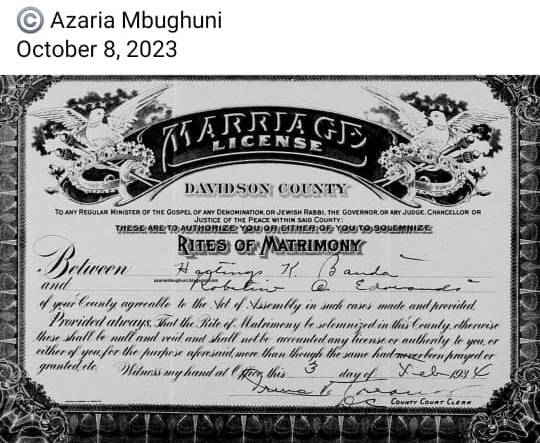
In October 2023, Dr. Azaria Mbughuni of Lane College (Tennessee, USA) shared digitised archival material revealing that on 3 February 1934, Hastings Kamuzu Banda formally married Ms. Robertine Edmonds at the Davidson County Court in Tennessee. This archival disclosure added a new dimension to scholarly and public discussions about Banda’s early life in the United States and contributed to ongoing historical re-evaluations grounded in documentary evidence.
4. Self-Government Celebrations (1963)
On 3 February 1963, national celebrations for the attainment of self-government were held at Rangely Stadium in Blantyre. Two days earlier, Dr Kamuzu Banda had been sworn in as ‘Prime’ Minister at the State House in Zomba. On this day, he appeared publicly for the first time in his capacity as ‘Prime’ Minister of Nyasaland, marking a decisive constitutional transition from colonial administration toward internal self-rule.
5. Arrest of University Students (1983)
On 3 February 1983, six students from the University of Malawi were reportedly arrested on suspicion of conspiring to establish a Marxist political party. Among them was Edge Kanyongolo, later a distinguished Professor of Law at the University of Malawi. This episode occurred within the broader context of one-party rule under Banda’s administration, where political dissent was tightly controlled and perceived ideological threats were treated with severity.
6. Administrative Tensions & Regional Policy (1989)
On 3 February 1989, senior civil servants returned to their offices after meeting Life President Dr Kamuzu Banda at Sanjika Palace the previous day. Reports indicate that he accused technocrats of sabotaging his developmental agenda in the Southern and Central Regions.
Ten days later, during a rally in Ntcheu, Banda announced that teachers would henceforth serve in their region of origin—a directive that disproportionately affected educators from the Northern Region. This period was followed by dismissals of several high-ranking civil servants, including figures such as John Phiri (Principal Secretary, Trade and Industry), James Chatupa (Chief Geologist), GG Ntawali (Commissioner of Police, Central Region), Hastings Chunga (General Manager, SEDOM), and Stanford FC Munyenyembe (Chief Resident Magistrate, Blantyre). The episode remains a significant case study in administrative governance, regional policy, and state power.
7. The 2019 Presidential Election Nullification (2020)
On 3 February 2020, the Malawi Constitutional Court delivered its landmark judgment nullifying the May 2019 presidential election. The Court ordered fresh elections within 150 days and reinstated Dr Saulos Chilima as Vice President. The ruling was widely regarded as a watershed moment in Malawi’s constitutional democracy and attracted global attention for judicial independence and electoral jurisprudence in Africa.
8. State of the Nation Address (2022)
On 3 February 2022, President Lazarus Chakwera delivered a State of the Nation Address during the opening of the 49th Session of Parliament. The address followed a cabinet reshuffle announced shortly beforehand and addressed issues of governance, economic recovery, and public sector reform.
9. Civil Society and Anti-Corruption Advocacy (2023)
On 3 February 2023, representatives of civil society organisations gathered at Parliament in Lilongwe to express concern over the interdiction of Martha Chizuma, then Director of the Anti-Corruption Bureau. Legislators were reportedly advised not to engage directly with the activists on security grounds. The episode reflected ongoing tensions around anti-corruption efforts and institutional independence.
#Lost History Foundation